The lion: totem of sovereignty and courage
June 27, 20265 min read
Royalty as an inner state
The lion does not need to proclaim its power. It carries power. Across every civilisation that has observed or imagined it, the lion embodies something beyond brute strength: a quiet authority, a presence that commands respect without demanding it. Universal totem of sovereignty, it symbolises the ability to hold one's territory, in the deepest sense of the word, meaning the inner space where one refuses to be dictated to.
The Egyptians stationed it as guardian of thresholds. The Romans emblazoned it on their standards. Medieval alchemists saw in the red lion the solar principle, the fire that transforms and reveals. Everywhere, across centuries, the same intuition holds: the lion does not dominate through violence, but through the undeniable evidence of what it is. Its mane is a crown that no one placed there.
To carry the lion as a totem is to align with this quality of presence. Courage, yes, but not the absence of fear. Rather the capacity to act despite fear, to move forward without justification, to inhabit fully the space that belongs to you. A sovereignty that is not negotiated.
The palette knife mane: a technique for an energy
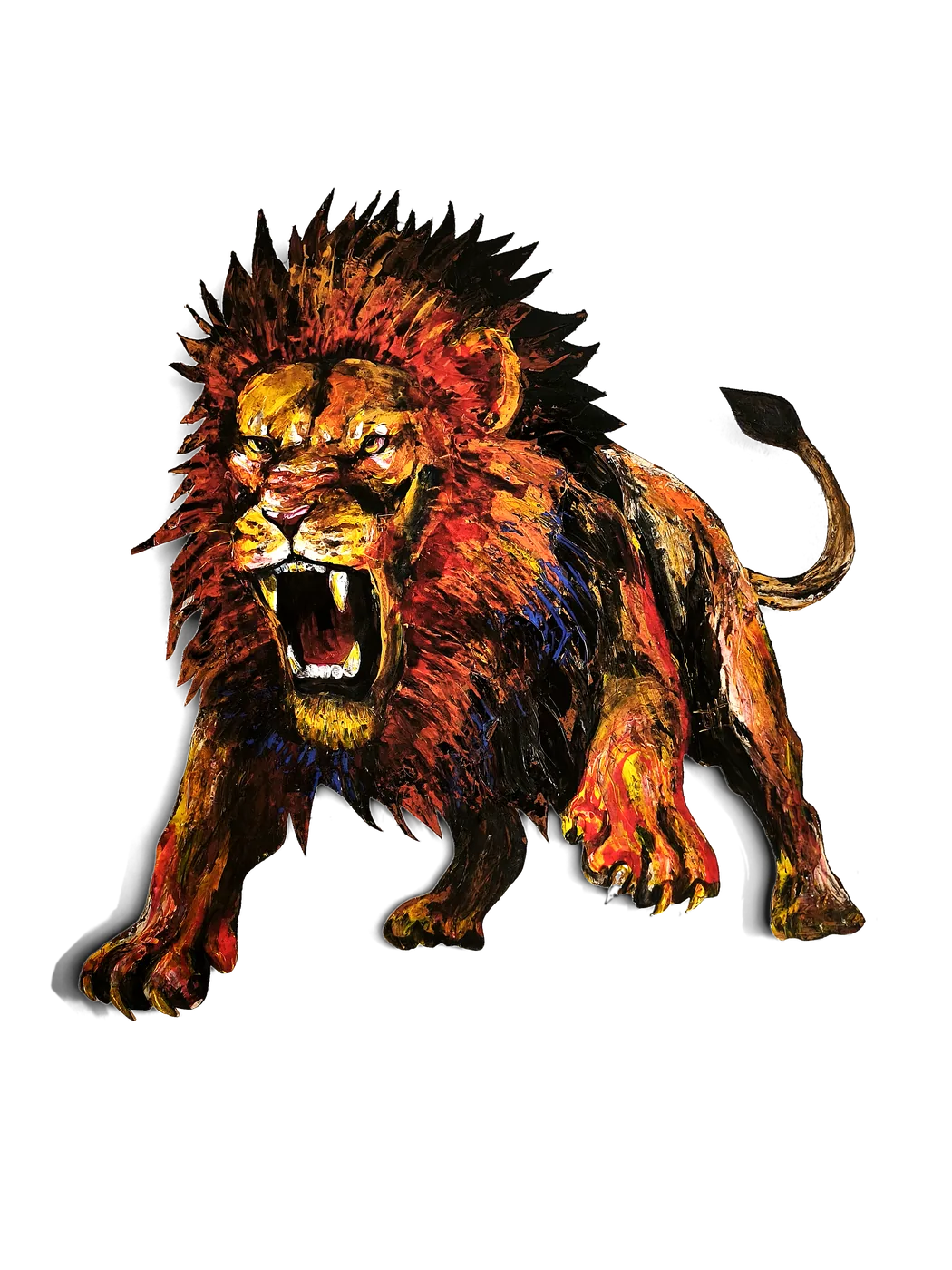
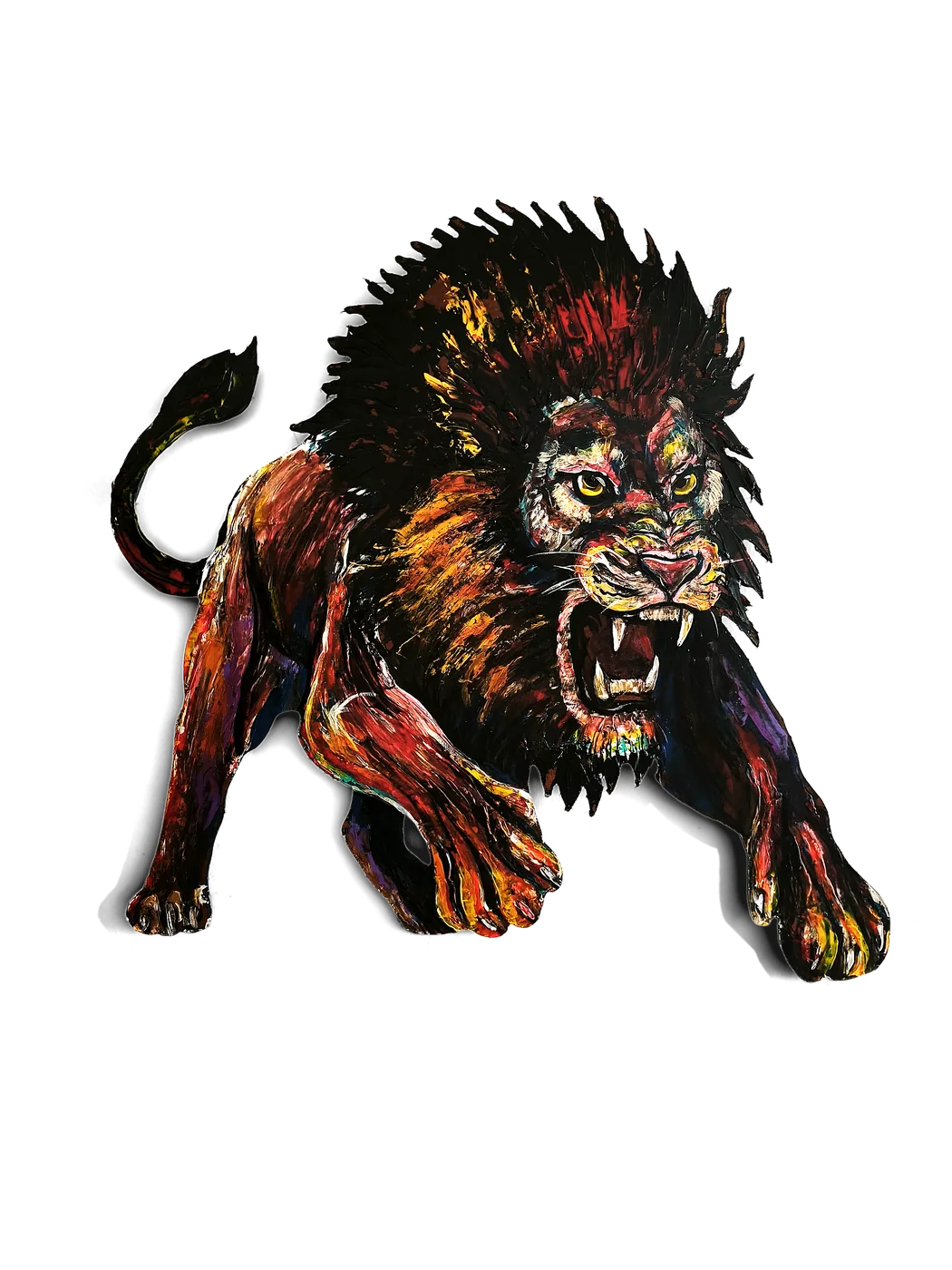
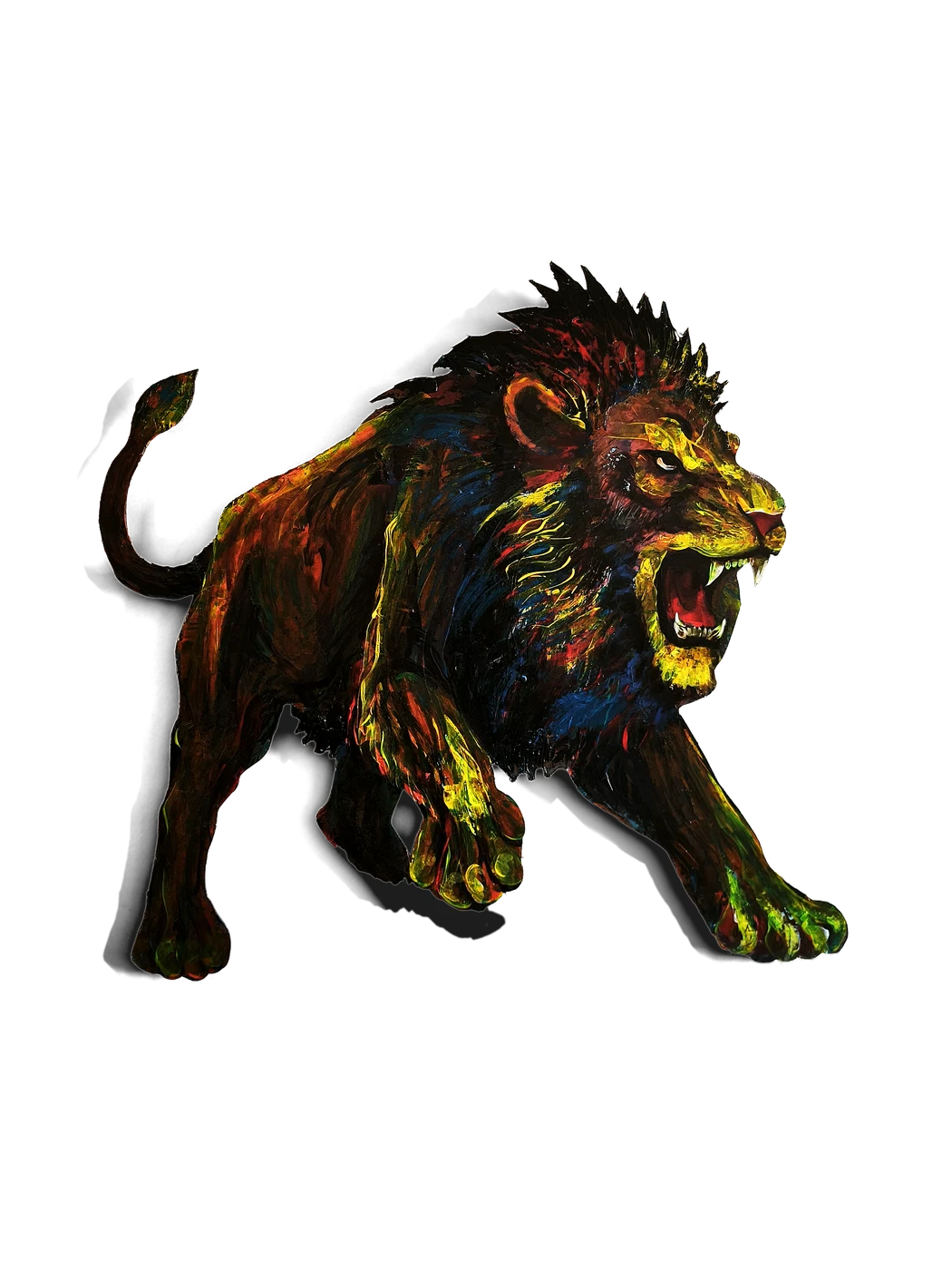
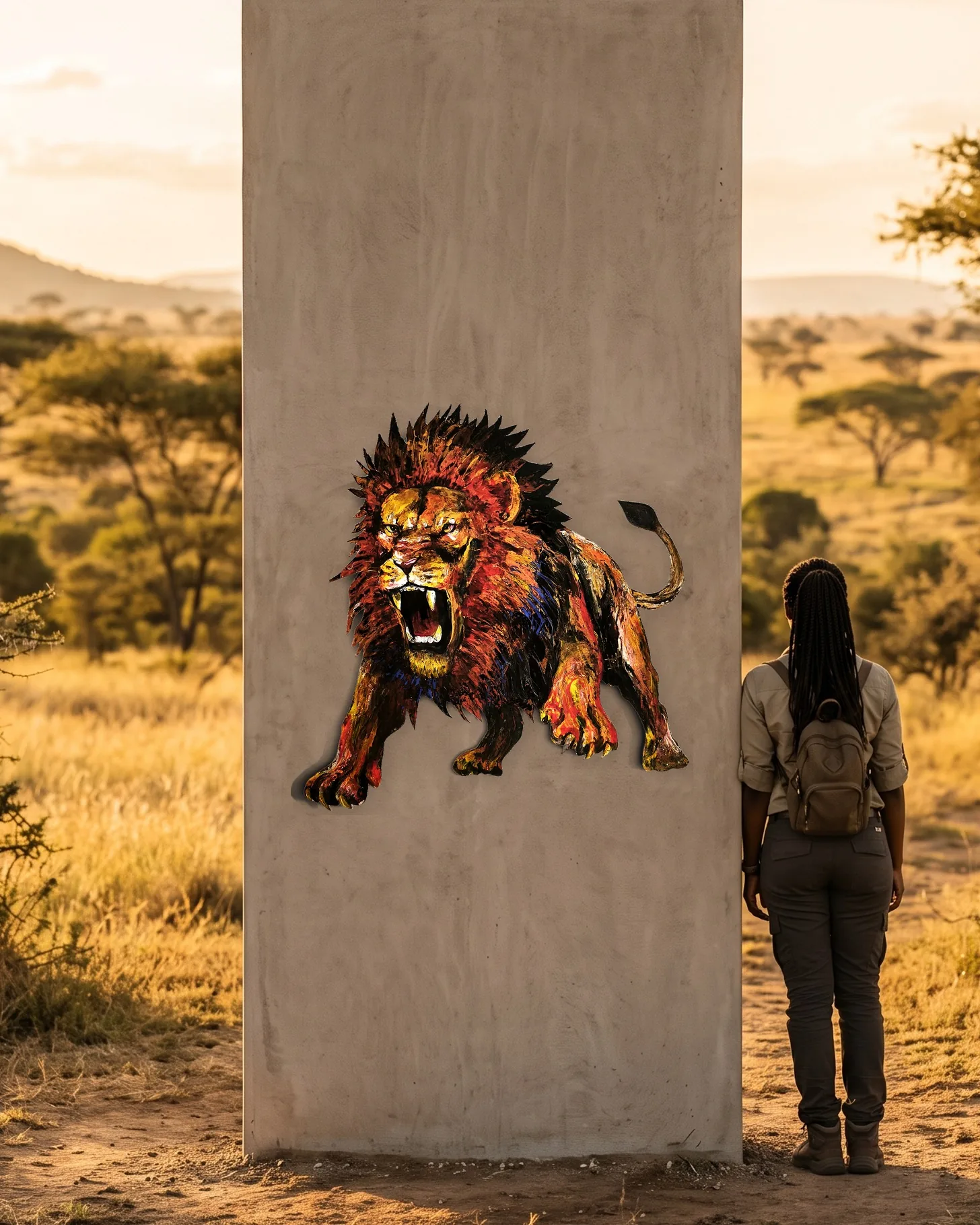
Rendering this density on a flat surface is a genuine challenge. The answer lies in the material itself. Acrylic paint applied with a palette knife leaves no room for hesitation: each stroke is a committed gesture, a chosen direction with no possibility of return. The paint accumulates, rises, creates relief that catches light differently depending on the viewing angle, the hour of the day, the distance from which one stands.
The lion's mane lends itself particularly well to this approach. Layered thicknesses, fanning striations, zones where the paste is almost sculpted rather than painted: the result does not imitate fur, it translates the inner dynamic of it. One perceives movement without it being frozen, density without heaviness. The material speaks before the eye has even identified the animal.
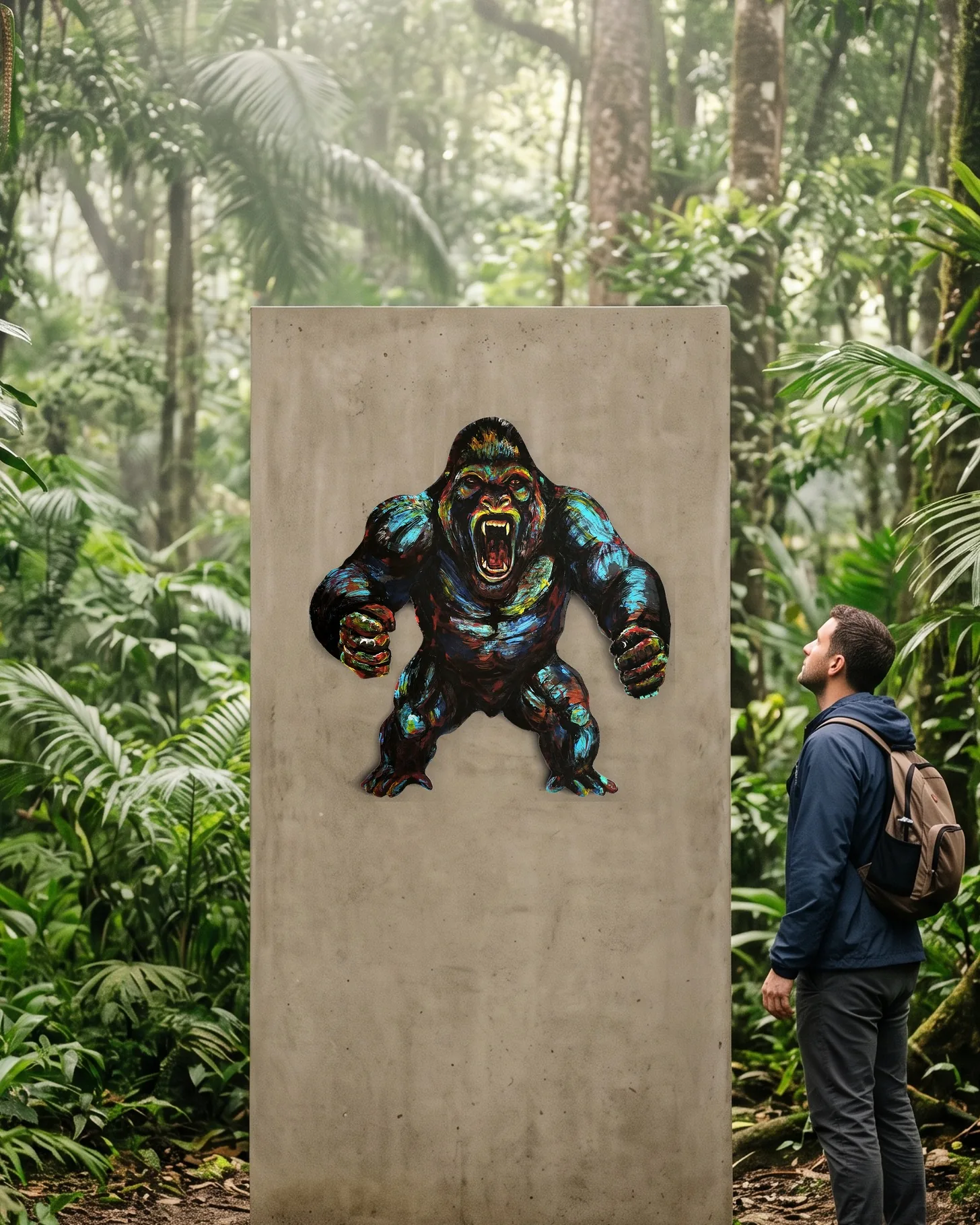
The support is an Isorel panel cut to the silhouette of the animal. No rectangle of canvas with neutral edges: the piece exists as an object in its own right, as a wall presence that asserts its own form. Placed against a wall, it casts a shadow that extends the outline. It is not a framed and neutralised representation. It is a presence in the space, with its own limits, its own silhouette recognisable from a distance.
Le Solaire and Le Nocturne: two faces of the same royalty
Within the collection Les Souverains, two pieces explore the lion under opposing lights, as though a single archetype could hold two equally true realities.
Le Solaire is built in ochres, golds and warm reds. The mane radiates, opening outward. The knife work is fully visible in its richness: generous material, strongly raised marks, areas where the paint has been laid with an abundance that evokes the heat of midday sun. This is the diurnal lion, the one solar cultures glorified since antiquity, a symbol of outward authority and light carried towards the world. A royalty that shows itself, not out of vanity, but because that is its nature.
Le Nocturne takes the opposite position. The palette closes towards deep browns, blacks with blue undertones, a dark background against which the silhouette is cut with almost mineral clarity. The mane is handled differently here: less expansive, more concentrated, as if the animal were drawing its energy towards an invisible centre. This is the lion of the night, the one that watches and observes, whose strength is no less real for being less visible. An introverted royalty, perhaps more unsettling, certainly more mysterious.
Each piece stands alone, in its own logic. Together, they form a natural diptych, a dialogue between two polarities of the same archetype. Side by side, they pose a simple question: which of these two sovereignties resembles you?
The lion in an interior: choosing a presence, not a decoration
A knife-painted animal work on Isorel is not chosen the way one chooses a cushion colour. It introduces an energy into a space, it modifies the atmosphere of a room in a lasting and subtle way. The lion, in particular, installs something simultaneously calm and dense, a light gravity that does not oppress but anchors.
In a study, it recalls axis, decision, the ability to hold course when circumstances invite compromise. In a living room, it creates a focal point that structures the whole without overwhelming it. In an entrance hall, it immediately establishes the register of the home and those who inhabit it.
The silhouette cut amplifies this effect of presence: no rectangular frame to contain and normalise, no border to signal that this is merely one image among others. The animal exists in space as it would exist in nature, with its own contours, its own sovereign form, its own right to occupy the wall.
Every piece is unique, signed, accompanied by a certificate of authenticity. Acquiring a work is also entering into a relationship with a singular, non-reproducible artistic practice that will not be found anywhere else.
Choosing your totem
The symbolism of the lion crosses cultures because it touches something universal: the desire for sovereignty over one's own life. Not domination over others, but inner clarity, quiet courage, natural authority that does not need to justify itself in order to exist.
To bring a piece from the collection Les Souverains into a space is to choose to live with this daily reminder. The material, the relief, the physical presence of the Isorel panel cut to the silhouette: everything contributes to making the work something other than an image hung on a wall. A presence. A totem, in the most original sense of the word.
Three lions inhabit the Les Souverains collection: Le Solaire, Le Traqueur and Le Nocturne.