The buffalo as totem of resilience: telluric power and grounding in animal art
June 28, 20265 min read
The telluric power of the buffalo
Across shamanic traditions on every continent, the buffalo holds a singular place. Not the cheetah's speed, not the fox's cunning: the buffalo embodies something deeper, harder to name. A presence. A density. The capacity to endure without yielding.
The peoples of the North American great plains called it the "great provider": its body fed, its hide protected, its bones made tools. But beyond utility, the buffalo carried a teaching. The land is not conquered, it is inhabited. Endurance is not stoicism, it is rootedness. Moving through the storm, head lowered, hooves in the mud, without surrender and without unnecessary force.
This symbolism crosses cultures. In Southeast Asia, the water buffalo has drawn the plow for millennia, tutelary figure of patience and fertility. In Africa, the Cape buffalo is feared as much as respected: unpredictable, solitary at times, yet inscribed in the chain of the living with an authority that nothing displaces.
The buffalo as totem means anchoring to the earth. Not the dreamed, idealized earth: the real earth, heavy, clay-like. The earth we walk upon, the earth we work, the earth that holds us upright.
Why the buffalo in interior decoration
The buffalo head settles into a space with natural authority. It is not the hunting trophy, nor the industrial resin copy found in standardized decoration catalogues. It is a chosen presence, a decorative intention that says something about the person who displays it.
In a living room, a study, a hallway at the entrance of a home: the buffalo anchors. It gives an axis. It organizes the gaze and the space around it without dominating, simply by existing with density.
The movement of contemporary interior design, particularly in its most refined forms (Scandinavian minimalism, Japanese wabi-sabi, raw industrial interiors), has rehabilitated the animal as an object of meaning. Not as folkloric decoration, not as nostalgia. As a reminder. A reminder that the living precedes architecture, that matter has memory, that certain forms speak to something ancient within us.
The buffalo head, when treated with care and genuine artistic vision, becomes a centerpiece. It does not illustrate: it bears witness.
The buffalo head series at Totem Sauvage
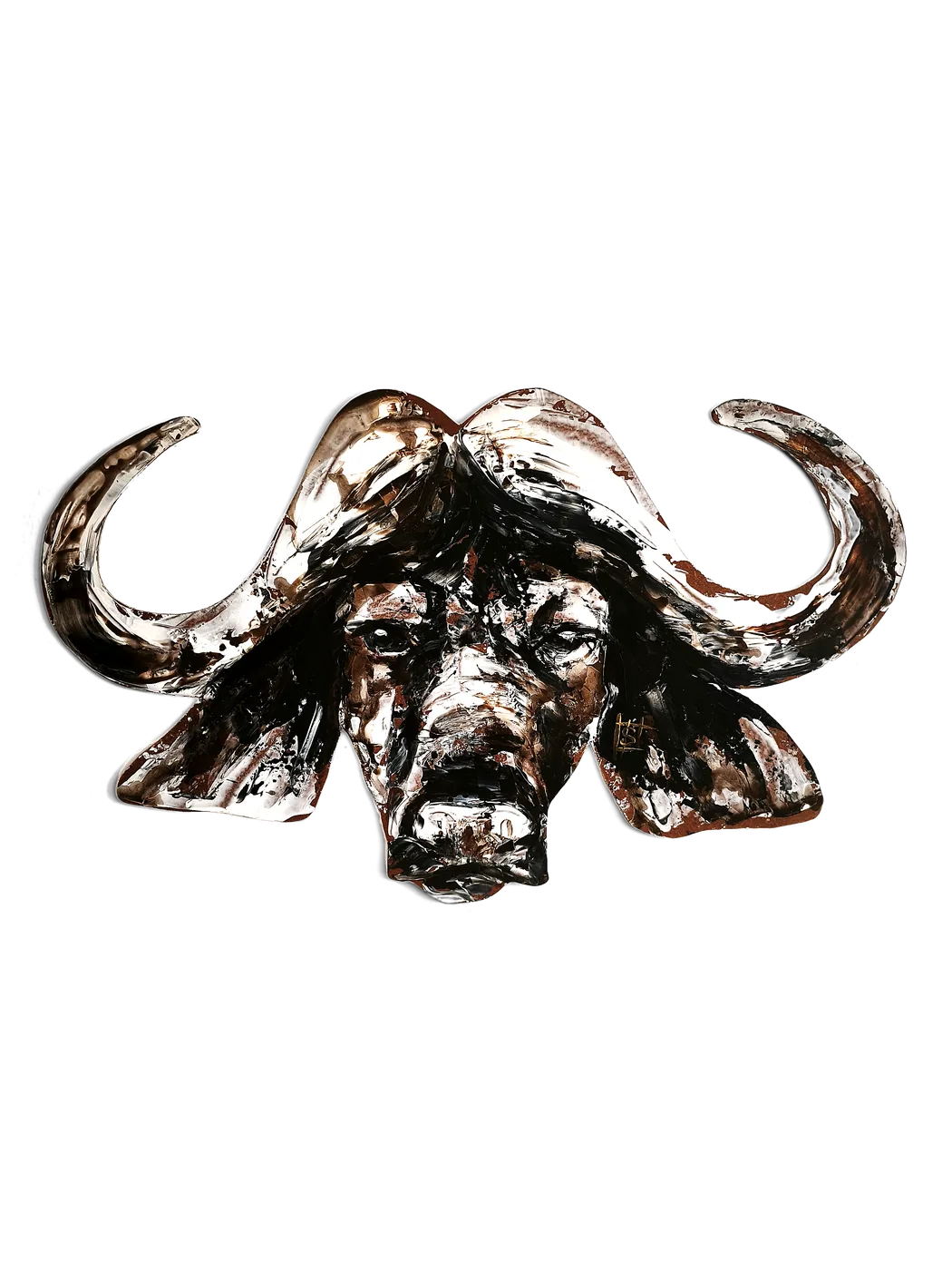
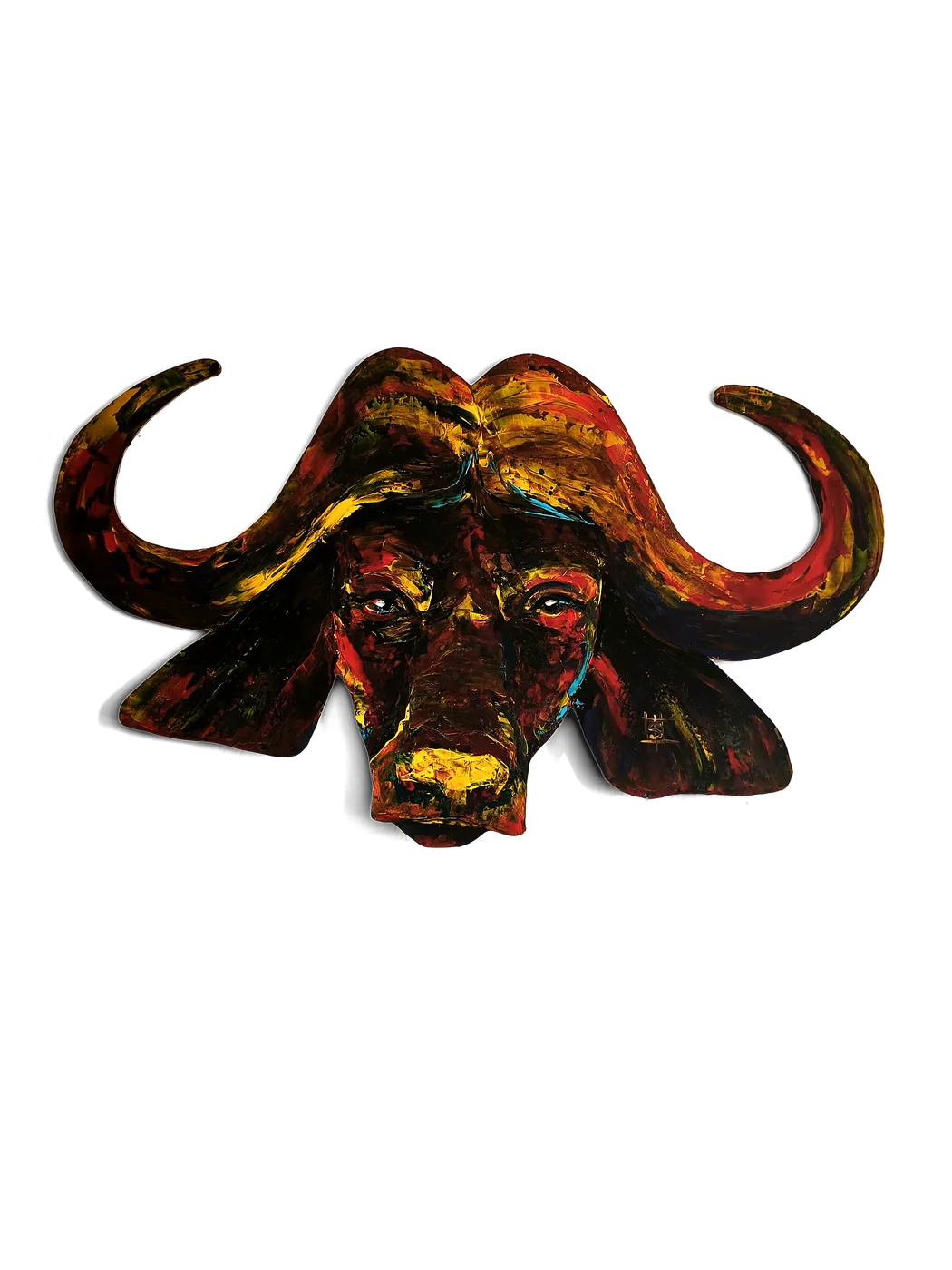
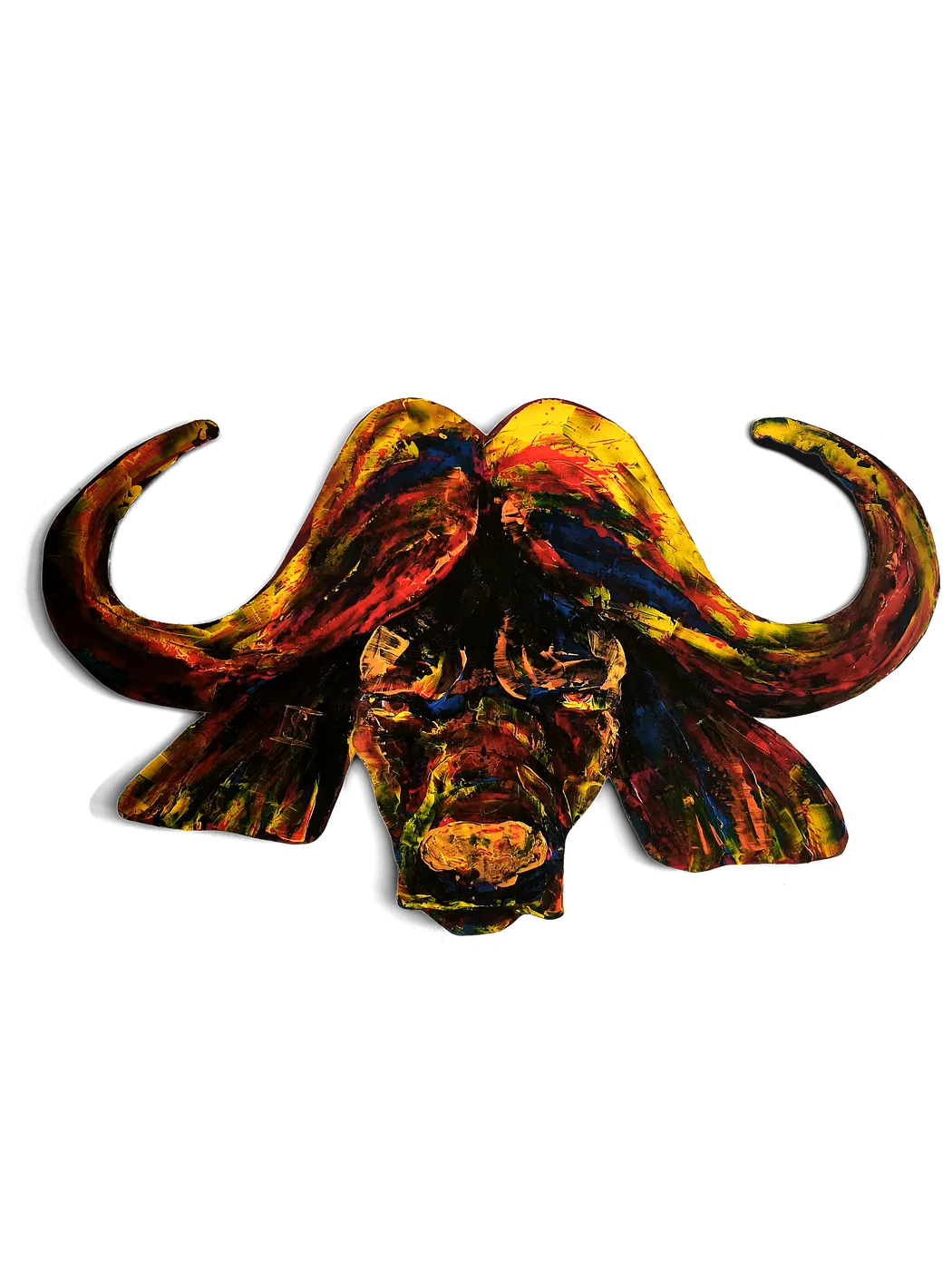
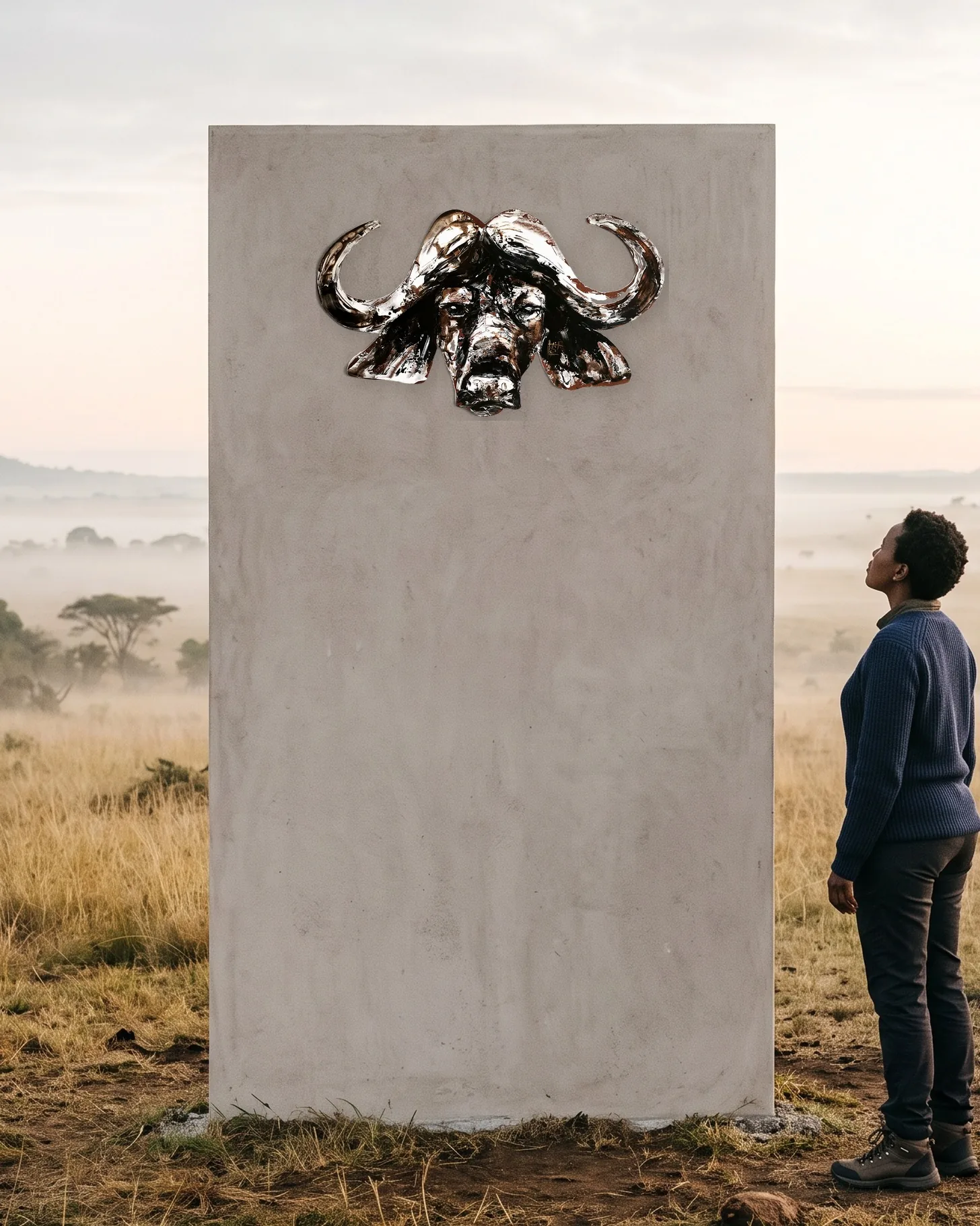
Camille developed for Totem Sauvage a series of buffalo heads rendered in distinct chromatic ranges. Each piece belongs to the Les Titans collection, conceived for animals of monumental presence.
The approach is not photographic realism. Each buffalo head is an interpretation, a reduction to the essential lines of the animal, amplified by color and texture. The chromatic ranges explore contrasted territories: deep blacks shot through with warm reflections, anthracite grays evoking rock and storm, earthy tones (ochre, brown, sepia) anchoring the piece in the vegetal and mineral, and bolder versions, almost graphic, playing on the contrast between a dark silhouette and a background treated as a flat color field.
These variations are not cosmetic declinations. Each chromatic range transforms the reading of the piece, its visual weight, its tension. A charcoal-black buffalo speaks differently from an earth-brown buffalo. One evokes the night, density, stillness before motion. The other recalls the soil, low warmth, the slowness of seasons.
All pieces are signed and accompanied by a certificate of authenticity. They are unique works, unreproducible.
The knife technique on shaped Isorel panel
What distinguishes each Totem Sauvage buffalo head, beyond subject and color, is the technique and the support.
Camille works with acrylic paint applied by knife (palette knife), on an Isorel panel. Isorel, made from compressed wood fibers, offers a dense, lightly grained surface that responds differently from stretched canvas. The material does not simply receive the paint: it absorbs and registers it. The palette knife presses, scrapes, accumulates paint in successive layers that create a tangible relief.
Knife painting is not a technique of precision. It is a technique of commitment. Every gesture is visible, every pass of the blade leaves a trace: a ridge of matter, a torn ground, a peak of dried paint. The result is a surface that plays with light in a way impossible to reproduce through printing or brush painting. Shadows and reflections shift depending on the angle, the time of day, the light source in the room.
The panel is then cut to the silhouette of the animal. This choice is not incidental. The cut shape frees the work from the rectangular frame, gives it a three-dimensional presence on the wall. The buffalo exists in space, not within a rectangle. Its silhouette stands out, and with it, all the energy that the painting has concentrated.
This silhouette cutting is also an act of artisanal precision: each panel is worked individually, by hand, so that the outline follows exactly the lines of the composition.
Placing a Totem Sauvage buffalo in your space
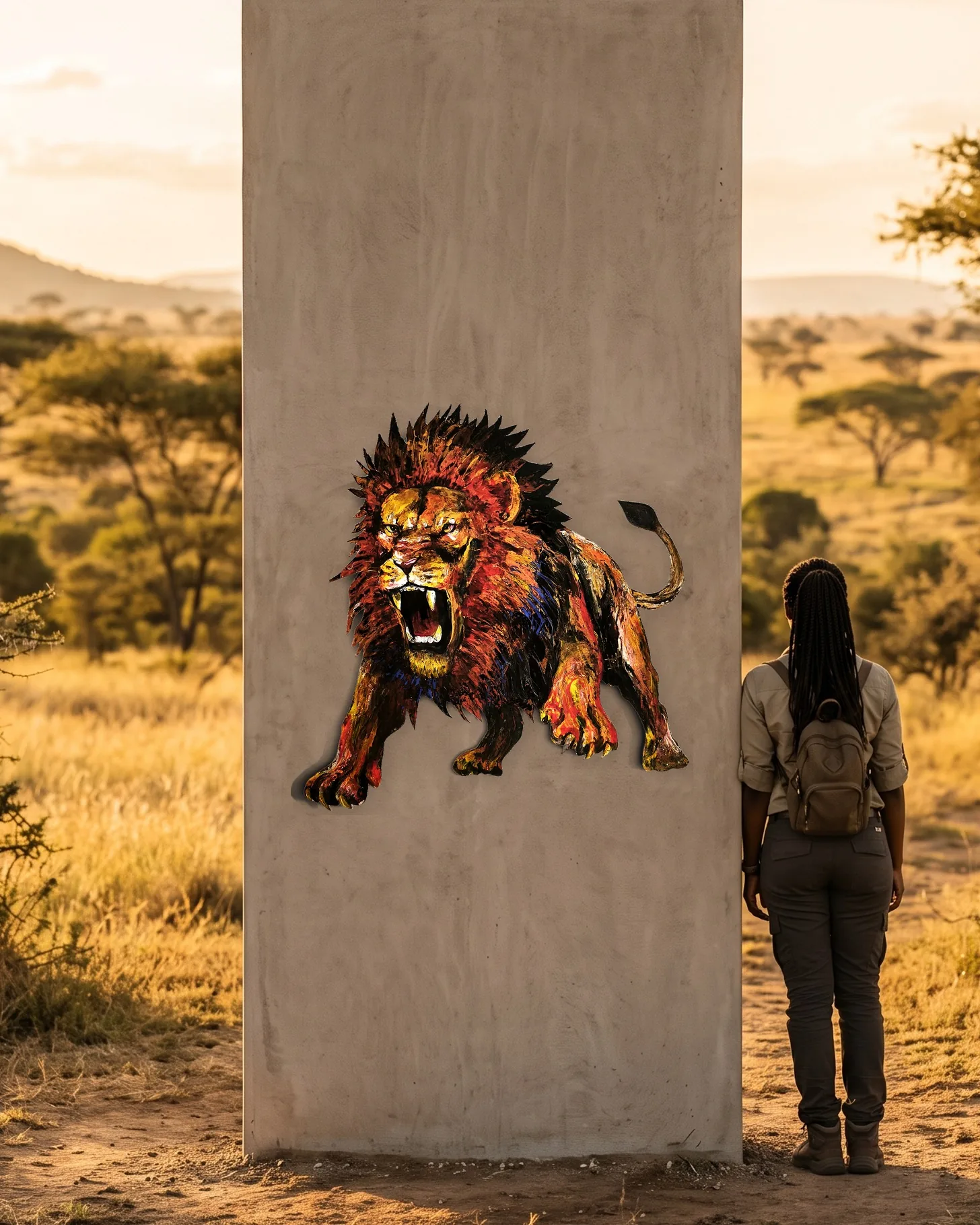
Placement matters. A buffalo head cut from an Isorel panel hangs like a painting but lives like a wall sculpture. It calls for a bare wall, a raking light that reveals the relief of the material, a space that gives it room to breathe.
It pairs well with raw materials: polished concrete, natural wood, exposed stone. It can also settle into more classic interiors, provided it is given the place it deserves: not crowded between two other pieces, not lost on an overloaded wall.
Each piece in the Les Titans collection is delivered ready to hang, with its certificate, and can be accompanied by guidance on choosing the right chromatic range for your specific space.
The buffalo waits. It has always waited. That is its nature: to hold the ground, to hold the time, to hold the light. The wall is yours to choose.
To welcome this grounding into your home: L'Enraciné, L'Ambre and Le Brasier, palette-knife buffalo heads.