Horse totem animal meaning: freedom, momentum and energy
October 16, 20264 min read

The horse as a totem animal stands, in popular readings, for freedom, momentum, energy and nobility. This article recalls those common meanings, then presents the reading of Camille Marchand, an animal painter: rearing horses painted with a palette knife, one piece at a time.
What does the horse mean as a totem animal?
People speak of a totem or spirit animal to name the animal they identify with and whose image they like to keep close. This is not a particular tradition: these are common symbolic readings, as you meet them today when you look up what the horse "says" about us. Four ideas keep coming back.
- Freedom. A horse running with its mane in the wind is the very picture of open space.
- Momentum. The horse is tied to movement, to setting out, to energy getting under way.
- Energy. Its muscular power makes it a symbol of vitality and strength.
- Nobility. Its carriage and upright presence suggest authority without brutality.
These meanings are interpretations, not facts. They matter mostly for what they make you feel in front of the image. For the long history of horse imagery, from prehistory to today, read our article the horse in art, from prehistory to the present.
Four horses, four readings
Camille Marchand paints rearing horses in acrylic with a palette knife, on hardboard panels cut to the animal's silhouette. Each painting is a unique, signed piece. Each page offers a reading of the horse it presents: a quality attributed to the piece, not knowledge handed down by a tradition. Here are four of those readings, from the collection of original equestrian paintings at Totem Sauvage.
On its page, Le Solstice is the horse of the tipping point: the moment you choose to set off higher. It is the totem of renewal, of the threshold crossed rather than the routine.
L'Aérien is strength made light, power that no longer needs to weigh in order to exist. It speaks to anyone who wants to rise without forcing anything.
L'Incandescent carries the fire one has within, an intensity that asks no permission to burn. Its page offers it to those who own their flame.
Le Flamboyant celebrates life without restraint: colour as a joy that refuses to apologise.
Each horse, then, carries a different meaning. The same animal can stand for renewal, lightness, intensity or joy, depending on the palette and the gesture. That is the point of the series: let each person recognise the one that speaks to them.
Why a rearing horse
The rearing horse is a suspended instant: the animal rises, forelegs in the air, between restraint and leap. That moment gathers almost everything people read into the totem horse, freedom, momentum, energy, and it suits palette-knife painting well. The paint is laid down in successive ridges, visible to the naked eye across the whole surface, and the cut panel lifts the silhouette off the wall like a relief. Depending on the hour, raking light moves the shadows and the piece changes its look.
The horses of Les Cavaliers all measure 60 x 102 cm, at 190 euros. A 30% deposit reserves the piece for three months, with the balance due before shipping.
A different horse: L'Écuyer
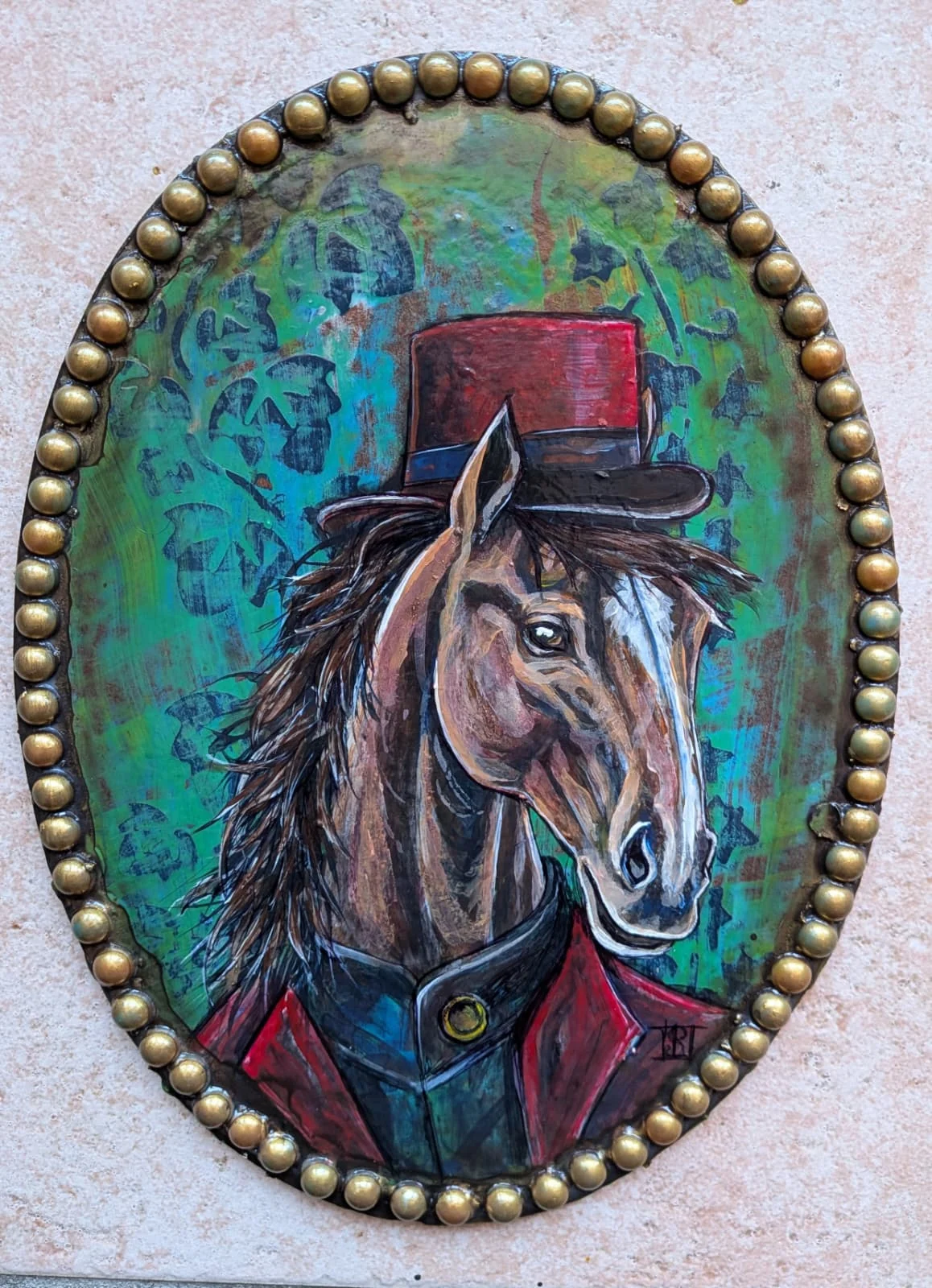
Not all of Camille's horses rear. L'Écuyer, from the Les Gentlemen collection, is a portrait: a bay horse with a white blaze, wearing a red top hat and a red jacket with a blue collar, against a turquoise green ground. It measures 21 x 28 cm, roughly an A4 sheet, and costs 120 euros, paid in full. Its page reads in it freedom that keeps its word: the horse runs, and it comes back.
Choosing your horse
There is no right reading. If you are looking for a totem horse for a wall, set the definitions aside and ask which of the four holds you first: the threshold of Le Solstice, the lightness of L'Aérien, the fire of L'Incandescent or the joy of Le Flamboyant. You can also browse the whole collection of original equestrian paintings. Each piece is unique: once sold, it does not come back.
The simplest way is to look at each painting twice: from a distance, for the horse's silhouette and attitude, then up close, for the marks of the knife. The first view tells of momentum, the second tells of the hand that laid it down. Both count in what we call, for lack of a better word, a totem: an image you come back to, day after day, because it sets something moving again.