The eagle, totem of vigilance and vision
June 25, 20265 min read
Sentinel of the Heights: What the Eagle Embodies
The eagle is not simply a bird. In nearly every culture that has named the forces of the world, it embodies what humans seek most stubbornly: absolute clarity, the quiet dominion of gaze, the capacity to hold the entire horizon without being overwhelmed by it. Sentinel of the heights, it observes without being seen. It decides without haste. Its soaring flight is not escape, it is sovereignty.
In Native American traditions, the eagle is the messenger between the earthly world and the celestial one. Its feathers carry prayers toward the sky. Its gaze transcends distances and illusions. For the Romans, it was the attribute of Jupiter, symbol of sovereign power and implacable justice. In European alchemical tradition, the eagle in flight signifies sublimation, the passage from raw matter toward pure spirit.
What all these traditions share is the idea that the eagle sees what others cannot. Its piercing vision, capable of spotting prey from several kilometres away, has become a universal metaphor: the ability to discern the essential within chaos, to maintain an overview without losing sight of detail. The eagle as totem calls toward this active vigilance, not suspicion or anxiety, but a total presence to what is unfolding, beyond appearances. It summons elevation, not as a flight from reality, but as the necessary distance to understand it more clearly.
It is this symbolism that Camille chose to place at the heart of the collection Les Sentinelles, of which "Le Veilleur" is the centrepiece.
The Eagle in Mural Art: The Question of Wingspan
Representing an eagle in mural art poses a fundamental question: how does one render wingspan? A folded eagle is merely one bird among others. It is in the opening of the wings that power resides, the sensation of commanding space, the aerial freedom that induces vertigo.
Large mural formats have always been the natural territory of the eagle throughout art history. From Byzantine mosaics to the frescoes of the peoples of the great plains, the royal bird finds its full meaning within architectural space. This is not simply a question of size, it is a question of presence: the eagle demands the entire wall, or at the very least defines its centre of gravity and imposes a reading of the whole space from itself outward.
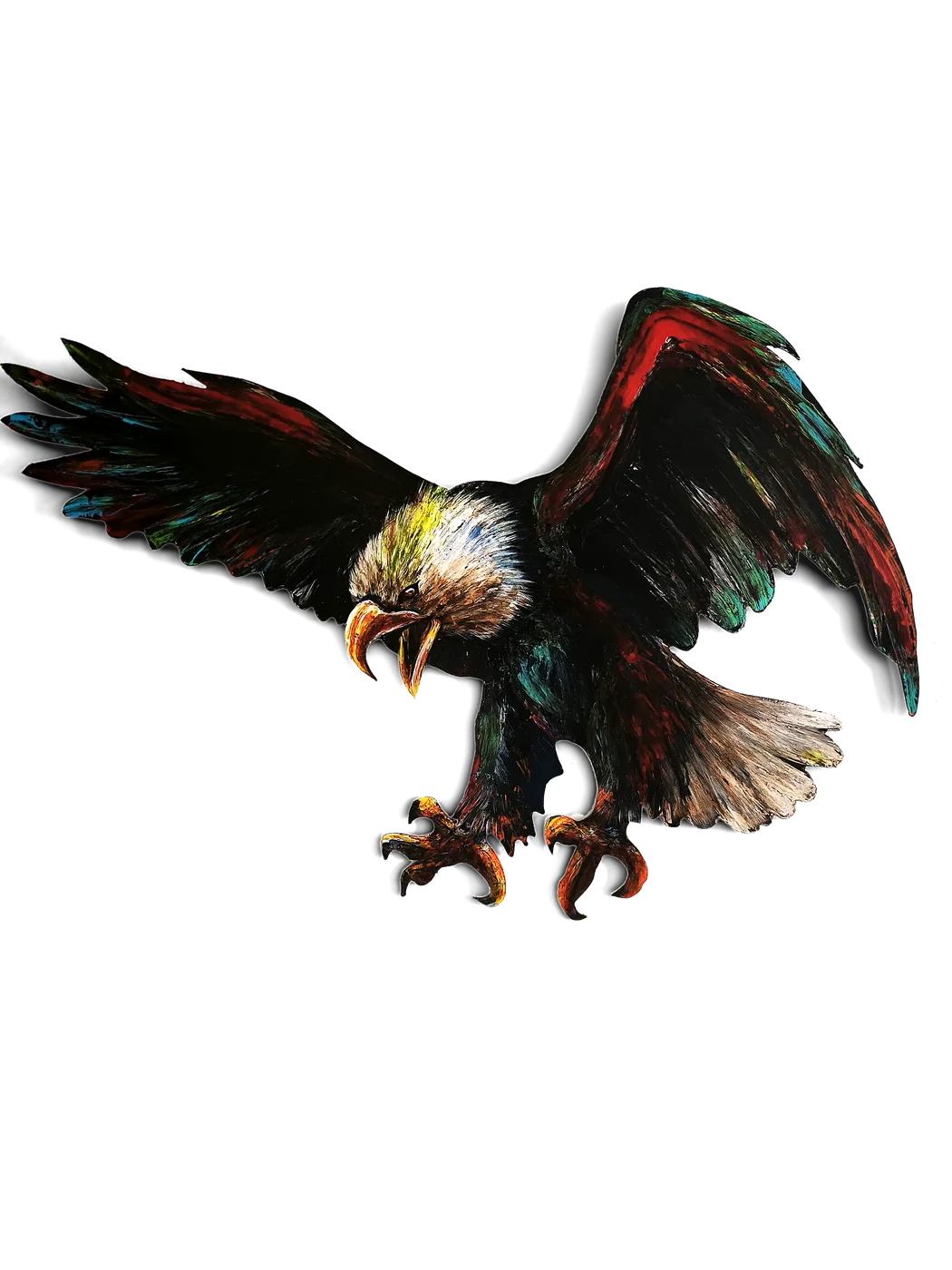
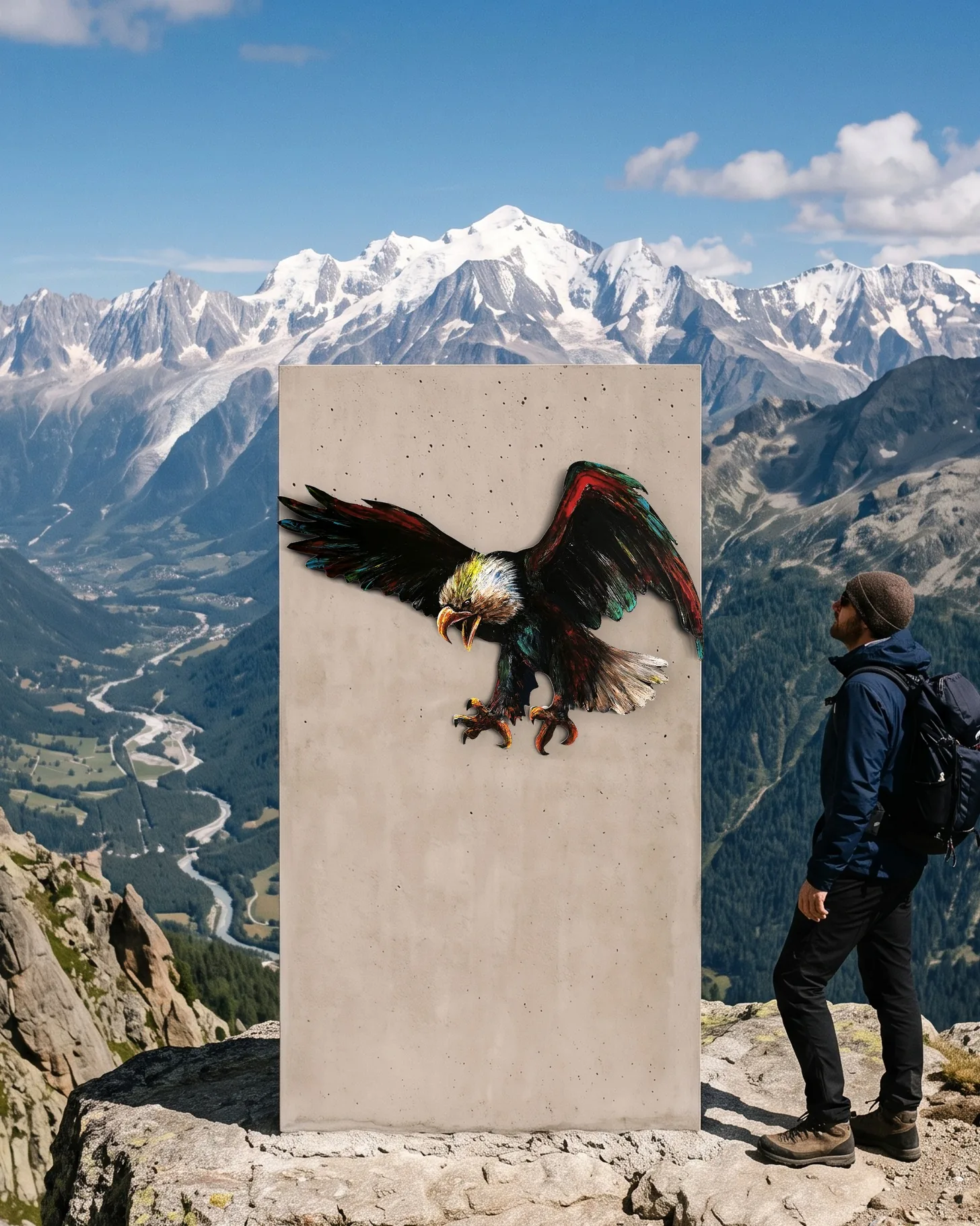
The usual temptation is to enlarge the support. Camille followed a different path, more radical and more consistent with her practice: by cutting the Isorel panel to the exact silhouette of the bird, the shape of the support becomes that of the eagle with wings spread. There is no longer a neutral background compressing the image, no rectangular frame constraining the reading. The work is the bird, and the bird is the work. This simple and decisive gesture is what gives "Le Veilleur" its particular presence on a wall.
"Le Veilleur": the Palette Knife, the Isorel, and the Life of Matter
"Le Veilleur" is built on an Isorel panel cut to the exact profile of fully spread wings. Isorel is a dense, homogeneous, and smooth material with properties very different from canvas. Acrylic paint adheres to it with firm hold, and the marks left by the palette knife remain sharp, almost architectural, like the barbs and rachis of a feather enlarged to infinity.
Camille works with the knife through successive layers and opposing tensions. She does not seek blending or softness: she seeks fracture, the line of force, the precise point where two colours meet and define each other. In "Le Veilleur", the warm tones of the inner feathers, deep brown, oxidised amber, burnt ochre, contrast with the near-absolute black of the outer primary feathers. The surface vibrates with these oppositions, it does not yield to a single glance.
At the centre of the composition, the eye. Treated with concentrated precision that stands apart from the rest of the knife-worked surface, it fixes an invisible point somewhere beyond the wall. This eye is the pivot of the entire piece: it justifies the title, it reminds that the wingspan is only the means by which the gaze travels.
The silhouette cut makes "Le Veilleur" a mural relief. Hung on the wall, the piece projects a shadow whose shape changes according to the direction and intensity of the light. In the morning, the shadow is long and oblique, entering into dialogue with the lines of the room. In the evening, it spreads darkly across the wall as though the bird were truly soaring through the space. The work is never quite the same from one day to the next.
A Unique Piece, a Lasting Presence
Each work in the collection Les Sentinelles is signed by Camille and accompanied by its certificate of authenticity. "Le Veilleur" is a unique piece: there will be no second version, no reproduction, no variation. The cut Isorel panel, the acrylic paint applied with a palette knife layer by layer, the silhouette that transforms the support into a real wingspan: all of this forms a singular object, destined to inhabit a precise space, to respond to a particular quality of light, to become an integral part of an interior that will be changed by its presence.
The eagle totem is not decoration. It is a constant, discreet, and sovereign presence. An invitation to maintain that piercing gaze on what is essential, to preserve elevation within the everyday. "Le Veilleur" does not keep watch: it witnesses that vigilance itself can be a form of beauty.
Discover the complete collection: Les Sentinelles.
The work born of this story: Le Veilleur, a palette-knife acrylic eagle.